
412-428-0008
Schedule a Consult
Now Accepting New Patients
One moment everything is fine. The next, you’re sitting in a damaged car, heart pounding, trying to figure out what just happened. Whether it was a rear-end collision on Route 88, a fender-bender in a parking lot, or something more serious on the highway, motor vehicle accidents have a way of turning your life upside down in an instant.
And the pain that follows? It doesn’t always show up right away. That’s one of the cruelest things about car accident injuries. You might walk away from the scene feeling shaken but okay — and then wake up two days later barely able to turn your head. That delay is your body’s stress response wearing off and reality setting in.
If that sounds familiar, here’s what you need to know: you have real options. Effective, drug-free, non-surgical options that are designed to get you back to the life you had before the accident. Right here in Bethel Park.
A car accident injury isn’t like a sports strain or an overuse injury. The forces involved in even a low-speed collision are significant. Your body wasn’t designed to absorb the sudden jolt of a motor vehicle crash — and the damage that results can be complex, layered, and easy to underestimate.
The tricky part is that the most common injuries from motor vehicle accidents don’t always show up on a standard X-ray. Soft tissue damage, nerve irritation, disc injuries, and ligament sprains can all be very real and very painful while appearing “normal” on basic imaging. That’s why so many accident victims are told they’re “fine” when they definitely don’t feel fine.
You’re not imagining it. And you deserve treatment that actually takes your pain seriously.
Let’s talk about whiplash, because it’s by far the most common injury we see following motor vehicle accidents — and it’s also one of the most misunderstood.
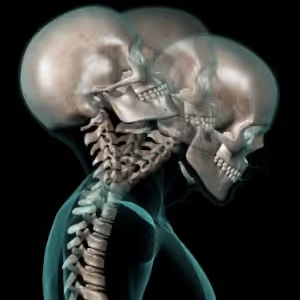
Whiplash happens when your head snaps forward and backward (or side to side) faster than your muscles can react. This rapid movement overstretches the soft tissues of your neck — muscles, tendons, ligaments — and can also affect the discs and nerves of your cervical spine.
Symptoms can include neck pain and stiffness, headaches, shoulder pain, brain fog, dizziness, jaw pain, and even tingling or numbness down into your arms. Left untreated, whiplash can become a chronic condition that affects your daily life for years.
The good news is that whiplash responds very well to the right kind of care — especially when that care starts early. The right combination of therapies, applied in the right order, can resolve whiplash completely and restore full function. That’s the goal, and it’s absolutely achievable.
Here in Bethel Park, we offer a comprehensive approach to car accident injury treatment that doesn’t rely on medications to mask your pain or surgery to patch things up. Instead, we use a combination of proven, evidence-based therapies that work together to address the root causes of your pain and restore your body to full function.
This is the kind of care that gets results — and has the documentation to prove it.
In a collision, your spine takes a beating. The sudden force can shift vertebrae out of their normal position, compress joints, and create nerve interference that causes pain, stiffness, and dysfunction throughout your body.
Chiropractic adjustments gently restore proper alignment to your spine and joints. When your structure is right, your nervous system works better, your muscles stop compensating, and your body can actually heal instead of just coping.
For car accident injury patients, chiropractic care is often the foundation of recovery. It addresses the structural damage that other treatments can’t reach — and it does it without drugs, without surgery, and without downtime. Many patients experience meaningful relief within their first few visits.
The muscles, tendons, and ligaments that were strained in your accident need direct attention. Left alone, they tend to heal with scar tissue — a rough, fibrous patch that restricts movement and often becomes a source of chronic pain.
Soft tissue therapy breaks up that scar tissue, restores circulation to damaged areas, and helps your body rebuild healthier, more flexible tissue in its place. Techniques like myofascial release, instrument-assisted soft tissue mobilization, and targeted therapeutic massage are all part of this process.
If your accident left you with a body that feels tight, restricted, or just “not right,” soft tissue therapy is often where the real breakthroughs happen. The relief can be significant — and the improvement in how freely you move is something you’ll notice in everyday life.
Here’s where our approach to car accident injury treatment in Bethel Park really stands apart: all of these therapies happen in one place, under one roof, with one coordinated care team.
That means your chiropractor, your soft tissue therapist, your laser and shockwave provider, and your clinical nutrition support are all working from the same playbook. When one part of your care changes, everyone knows. Adjustments happen in real time based on how you’re progressing. Nothing falls through the cracks.
Contrast that with the alternative — bouncing between a primary care doctor, a specialist, a physical therapist, and a pain management clinic, each working in isolation, none of them fully aware of what the others are doing. That’s not a care plan. That’s a scavenger hunt.
Integrated care under one roof is how you get from “just managing” to actually healed.
This matters especially for car accident cases: everything we do is evidence-based and meticulously documented.
Every exam finding, every treatment, every measure of progress is recorded in a way that clearly tells the story of your injury and your recovery. This documentation matters — not just for your health, but for your legal case.
We work hand in hand with attorneys representing accident victims. We understand what’s needed to build a clear, complete picture of how the accident affected you and what it took to get you better. Our documentation supports your case and helps ensure you’re not left paying out of pocket for injuries that weren’t your fault.
You shouldn’t have to fight your recovery and a legal battle at the same time. We make sure the clinical side is solid so you can focus on healing.
Not “a little better.” Not “manageable.” The goal is to get you back to pre-injury status — the way you felt, moved, and lived before the accident happened.
That means sleeping through the night again. Driving without gripping the steering wheel in pain. Playing with your kids, keeping up at work, enjoying the weekend — without your body reminding you every few minutes that something went wrong.
Real relief from a car accident injury isn’t just about quieting the pain. It’s about restoring your function, rebuilding your confidence in your own body, and reclaiming a quality of life that the accident tried to take from you.
That’s what we’re here for. And in Bethel Park, that level of comprehensive, drug-free, non-surgical care is right around the corner.
Get checked out as soon as possible, even if you feel okay. Adrenaline masks pain, and a lot of accident injuries don’t show up until a day or two later. I always tell people not to wait around hoping it’ll go away on its own. The sooner we know what’s going on, the sooner we can start actually fixing it.
You can, but I’d encourage you to ask some questions first. A lot of law firms have arrangements with certain medical clinics, and those clinics often lean heavily on medication to manage symptoms. That might build a paper trail for a case, but it doesn’t always line up with what actually helps your body heal. You always have the right to choose your own provider.
I’m not saying every attorney does this, but it happens more than people realize. Medication can create documentation of “ongoing treatment” for a claim, and some of these referral arrangements are built more around the legal case than your recovery. My concern is always the same: are we treating the person or just building a file?
Medication can take the edge off, but it doesn’t repair damaged tissue, realign a joint, or calm inflammation at its source. It just turns down the pain signal for a while. I’d rather find out what’s actually injured, whiplash, a disc, soft tissue damage, and work on correcting that directly instead of just numbing you to it.
Both have their place. If there’s a fracture or something requiring emergency care, absolutely see an M.D. But for the soft tissue injuries, whiplash, and joint problems that make up most accident injuries, this is exactly the kind of thing I focus on every day. A lot of my patients come to me after months of pills that never addressed the actual injury.
Whiplash happens when your head snaps forward and back faster than your neck muscles can control, straining muscles, ligaments, and joints in your neck. Because the damage is often to soft tissue rather than bone, it doesn’t always hurt right away. Some people don’t feel the full effect for 24 to 72 hours, which is why getting checked early matters so much.
Most soft tissue and whiplash-type injuries from car accidents do not require surgery. What they do require is proper evaluation and a plan to restore normal movement and reduce inflammation before things become chronic. Surgery gets reserved for structural damage, not for the majority of accident injuries I see walk through my door.
That’s exactly why an evaluation matters instead of guessing. Some injuries do resolve with time and proper care. Others, especially untreated joint misalignments or disc issues, tend to get worse and become chronic problems years down the road. I’d rather find out now than have you dealing with this pain a decade from now.
You don’t have to wait, and honestly, waiting usually makes recovery harder. The sooner you address the actual injury instead of just managing symptoms, the better your outcome tends to be, regardless of what stage your legal case is in. Documentation and healing are not the same goal, and I keep my focus on your body.
I’m not trying to build a file for a legal case. I’m trying to find out what got hurt in that accident and fix it, drug-free and without surgery whenever possible. That means a real evaluation, a real explanation of what’s going on in your body, and a plan built around getting you back to normal, not just keeping you medicated until your case closes.